
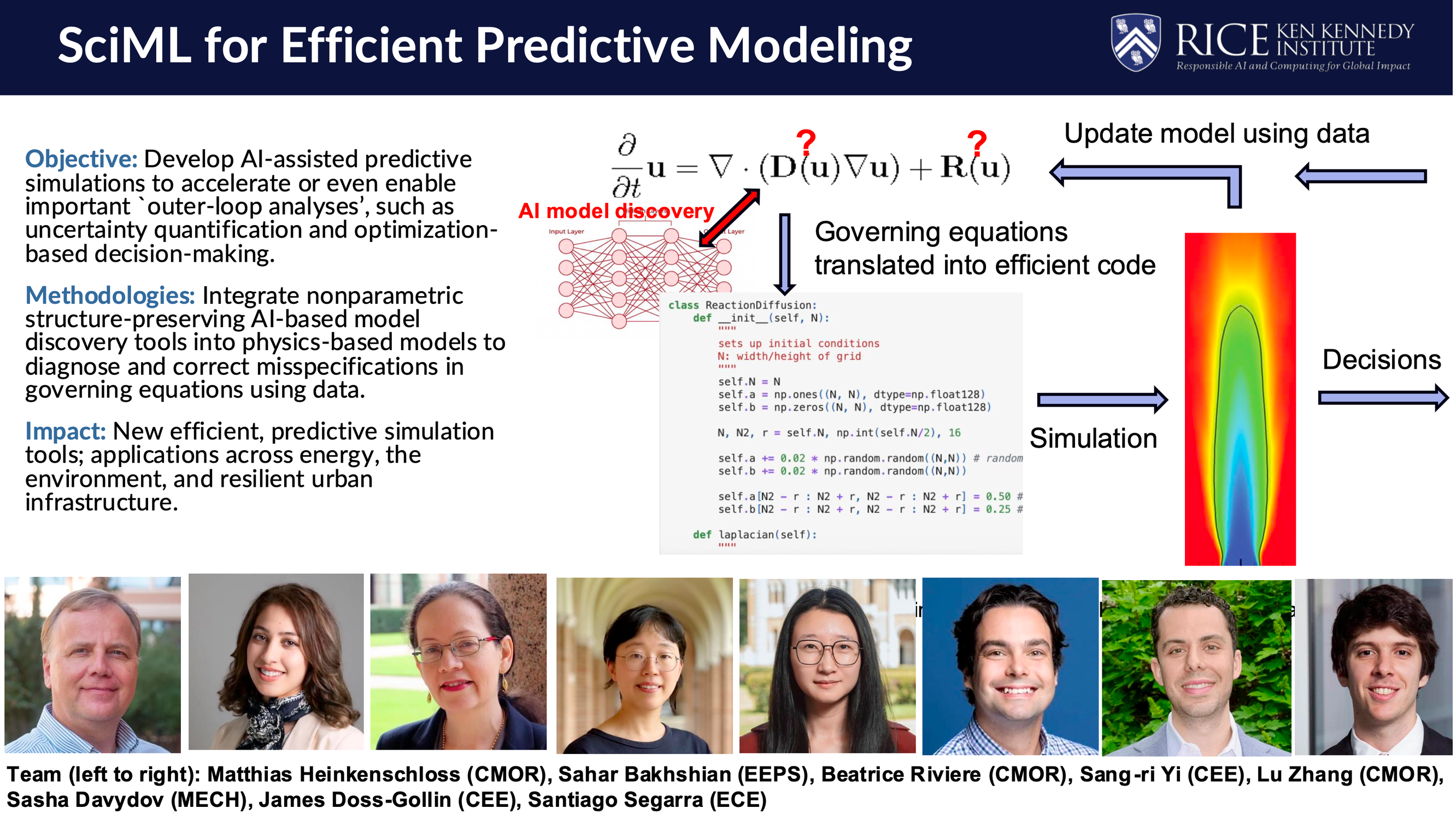
The SciML for Efficient Predictive Modeling group aims to develop AI-assisted predictive simulations to accelerate, or enable, important “outer-loop analyses,” such as uncertainty quantification and optimization-based decision-making, with applications across energy, the environment, and resilient urban infrastructure. The cluster's work integrates physics-based scientific computing models with data-driven AI models to develop new, efficient, interpretable, mathematically grounded computational models.
Cluster Members
- PI: Matthias Heinkenschloss (CMOR)
- Co-Is: Sahar Bakhshian (EEPS), Beatrice Riviere (CMOR), Sang-ri Yi (CEE), Lu Zhang (CMOR)
- Associates: Sasha Davydov (MECH), James Doss-Gollin (CEE), Santiago Segarra (ECE)
-
Research Vision
-
The vision of the SciML for Efficient Predictive Modeling cluster is to accelerate or even enable important `outer-loop analyses’, such as uncertainty quantification and optimization-based decision-making. This is accomplished by integrating physics-based scientific computing models with data-driven artificial intelligence (AI) models to develop new, efficient, interpretable, mathematically grounded computational models that are predictive for use in outer-loop analyses, where these integrated models are applied over larger ranges of parameter space.
We will develop methods, mathematical analyses, and computational tools applicable to broad classes of problems, and we will demonstrate tailored versions of our framework in energy, environmental, and resilient urban infrastructure applications, such as geological carbon storage and geothermal energy production, and quantification of natural hazard impacts on buildings. Thus, our project will contribute to Foundational AI & Computing, especially AI Interpretability and Physical AI, and to the AI & Computing for the Momentous "Premier Research” pillars Thriving Urban Communities and Sustainable Futures. Our project takes a broader view of Scientific Machine Learning (SciML), beyond fast simulation based on given governing mathematical equations, to discover, adapt governing equations or components thereof, and strategically generate data to guide this model adaptation, with the goal of constructing efficient models for outer analyses.
Arguably, the ultimate purpose of computational simulations is to support outer-loop analyses. However, traditional physics-based simulations suffer from limitations. First, high-fidelity scientific computing simulations are often too computationally expensive for outer-loop analyses. Second, they build on mathematical models that make assumptions about physical processes, which are often inaccurate, e.g., due to missing data or because the model scale does not fully capture processes at finer scales. As a result, the simulation fails to be predictive in many regimes that will be explored during outer-loop analysis tasks. On the other hand, AI models trained on data often lack interpretability, produce trustworthy results only for the domains of inputs and outputs on which they were trained, and therefore lack the predictive capabilities needed for outer-loop analyses. This proposal bridges the gap.
The specific goals of this proposal are:
- Integrate nonparametric AI-based model discovery tools into physics-based models to diagnose and correct misspecifications in the mathematical models using data. To achieve predictive properties of the combined model, it is crucial that the AI model is constrained and constructed to preserve important physical properties.
- Construct adaptive, efficient AI-based surrogate models to replace predictive, but computationally expensive simulations. Initial surrogate models will be built using initially available data, and then refined as needed with strategically generated data from existing computational science simulations. Moreover, the surrogates' basic structure will be constrained to preserve important physical properties.
- Demonstrate the new predictive simulation tools in applications across energy, the environment, and resilient urban infrastructure.
The project’s interdisciplinary team brings together mathematical and application-oriented computational scientists with extensive expertise in scientific computing, simulation of complex systems, and optimization-based decision-making, as well as experience in applying these tools to challenging problems in energy, environmental systems, and resilient urban infrastructure.