
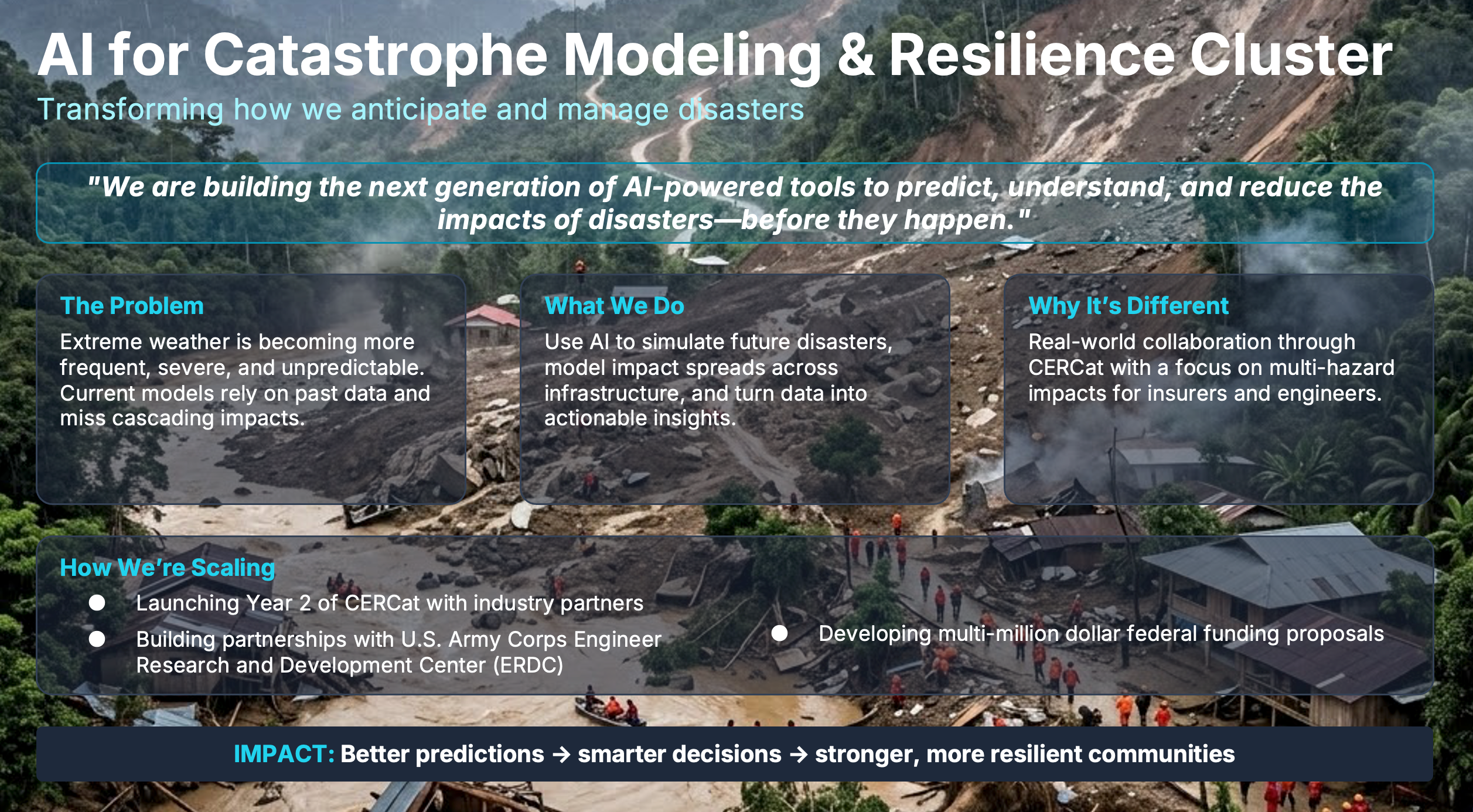
The AI for Catastrophe Modeling and Resilience cluster aims to transform disaster management through next-generation, physics-grounded AI frameworks that simulate rare, high-impact hazards—such as hurricanes and floods—and model their cascading impacts across interconnected infrastructure systems. Their work helps predict, understand, and reduce the impact of disasters before they happen, providing data-backed actionable insights that will help build stronger, more resilient communities.
Cluster Members
- PI: James Doss-Gollin (CEE)
- Co-Is: Avantika Gori (CEE), Kathy Ensor (STAT), Jamie Padgett (CEE), Xinwu Qian (CEE)
- Associates: Arlei Lopes da Silva (CS), Noemi Vergopolan (EEPS)
-
Research Vision
-
The increasing severity of extreme weather events and their complex impacts on communities motivate new approaches to understanding and managing climate risks. However, advancing cli- mate risk management is limited by models that generalize poorly, omit key human and physical processes, and are constrained by their computational cost. This research cluster advances a fo- cused vision: to transform the field through next-generation, AI-enabled, physically grounded, system-aware, and decision-relevant catastrophe modeling frameworks.
Our research is guided by three fundamental questions that define the future of AI-enabled resilience to extreme weather and its cascading consequences. First, how can artificial intel- ligence generate physically consistent and decision-relevant representations of extreme events under a changing climate? We aim to develop generative and physics-informed AI models to simulate rare, high-impact hazards—such as hurricanes, severe convective storms, and compound flooding—at scales relevant for infrastructure and community decision-making. Second, how can AI capture the nonlinear and cascading impacts of hazards across in- terconnected infrastructure systems? We will create hybrid AI-physics frameworks to model how disruptions propagate through energy, transportation, water, and built systems, enabling a shift from asset-level risk to system-level resilience modeling. Third, how can AI-driven hazard, exposure, vulnerability, and resilience models be trusted and operationalized? We will advance uncertainty quantification, validation, and explainability to ensure models are robust, interpretable, and aligned with industry and policy needs.
A central pillar of this vision is the expansion of Consortium for Enhancing Resilience and Catastrophe Modeling (CERCat) into Year 2 with a renewed portfolio of AI-focused research projects. This phase will deepen engagement with existing partners while expanding member- ship across insurers, reinsurers, and engineering firms, ensuring access to real-world data and alignment with operational priorities. In parallel, the cluster will strengthen collaboration with the U.S. Army Corps of Engineers (USACE) Engineer Research and Development Center (ERDC) through joint research and exchanges. The cluster will co-organize a flagship AI for Catastrophe Modeling and Resilience workshop with the Ken Kennedy Institute, bringing together 75–125 participants from academia, insurance, engineering, and government to showcase cluster research, align stakeholders on shared priorities, and develop future multi-sector proposals.
Impact. If successful, this work will fundamentally reshape how catastrophic risk is understood and managed. We aim to catalyze a transition from static, backward-looking models to dynamic, forward-looking simulations that capture evolving climate risks and multi-hazard interactions. Users of these models—including underwriting and risk management, infrastructure designers and managers, and local and regional governments—will gain tools to anticipate compound disasters, prioritize resilience investments, and allocate resources more effectively. More broadly, this re- search will establish a new paradigm integrating AI and physics-based modeling to address rare, high-consequence events at scale.
Team Strengths and Differentiation. This cluster stands out through its integration of interdis- ciplinary expertise into existing partnerships to produce use-inspired fundamental research. The team operates within an industry–academia partnership model through CERCat, co-developing research agendas with insurers, reinsurers, and engineering firms. The team also includes collab- orations with local governments, regional transportation agencies, financial institutions, engineer- ing design companies, and state and federal agencies. These collaborations provide access to proprietary datasets, validation pathways, and real-world use cases for use-inspired fundamental research.