
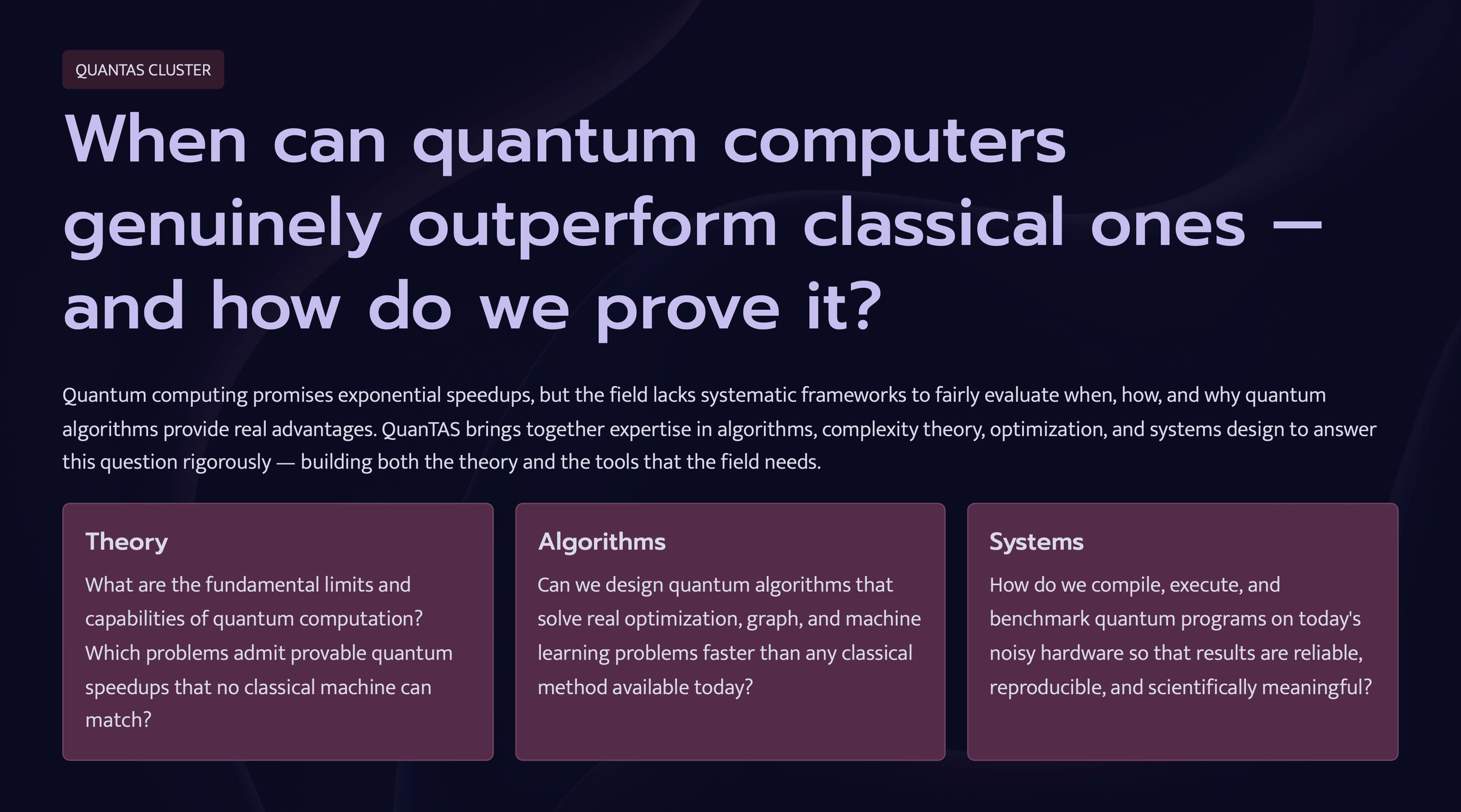
Quantum computing promises exponential speedups, but the field lacks systematic frameworks to fairly evaluate when, how, and why quantum algorithms provide real advantages. The QuanTAS cluster establishes a vertically integrated hub for quantum-computing research that combines theory, algorithms, and systems to determine when quantum computers deliver scientifically meaningful answers faster than classical methods—building both the theory and the tools that the field needs.
Cluster Members
- PI: Tasos Kyrillidis (CS)
- Co-Is: Tirthak Patel (CS), Shengxi Huang (ECE), Hengrui Luo (Statistics)
- Associates: Nai-Hui Chia (CS), Guido Pagano (Physics & Astronomy), Kaden R. A. Hazzard (Physics & Astronomy), Leonardo Duenas-Osorio (CEE)
-
Research Vision
-
Long-term objectives. QuanTAS aims to establish Rice as a national hub for vertically integrated quantum-computing research that asks one question with discipline: for a given hardware budget, can a quantum computer deliver a scientifically meaningful answer faster than the best classical method? Most US quantum-computing groups specialize in one layer — complexity theory, algorithms, or systems. QuanTAS unites all three under a single program with experimental anchoring in real Hamiltonians, and treats AI and machine learning as a cross-cutting layer that improves every level of the stack from within. Year 1 (of full cluster support, following the FY25 Aspiring Cluster award) demonstrated that this integration is uniquely productive at Rice.
Impact. Cluster outputs target three audiences. Scientific: honest, resource-bounded utility metrics for variational quantum algorithms on chemistry and materials Hamiltonians (DOE BES priority). National: direct contribution to the National Quantum Initiative Act priorities and to DOE/NSF emphasis on AI-for- quantum, with deliverables intended for hosting on the American Science Cloud (AmSC). Workforce: the Quantum Student Success Summit (QS3) at Rice, March 23–24, 2026; one K2I Andrew Ladd Memorial Excellence Fellowship recipient; a Ken Kennedy–HPE Cray Graduate Fellowship; multiple PhD students and postdocs co-advised across the four Co-I labs. Cluster postdoc Jianqiang Li has been accepted as a tenure-track faculty member at UT Dallas (Department of Computer Science), a direct workforce- development outcome of the cluster's Year-1 mentoring.
Team strengths and differentiation. QuanTAS is differentiated from peer groups by vertical integration with experimental anchoring. Each Co-I owns a distinct layer that no other US academic quantum group combines under one roof: Chia (theory) — quantum complexity, verifiability of quantum advantage, circuit lower bounds (Eurocrypt 2026, FOCS 2025, COLT 2025); Kyrillidis (AI and optimization) — Catalyst-QLSP (AAAI 2025 Oral), IP-PDT for VQE, Quantum EigenGame (CPAL 2025), Grover-QAOA on IonQ Aria (Quantum Sci. Technol. 2024); Patel (systems) — NEST (POMACS 2026), Anchor (SIGMETRICS 2026), Quorus (ICLR 2026), ResQ (ICCV 2025), SC 2025 Best Paper Finalist; Huang (experimental anchor) — quantum sensing and 2D quantum materials provide the Hamiltonians and target observables that make 'quantum utility' a falsifiable claim.