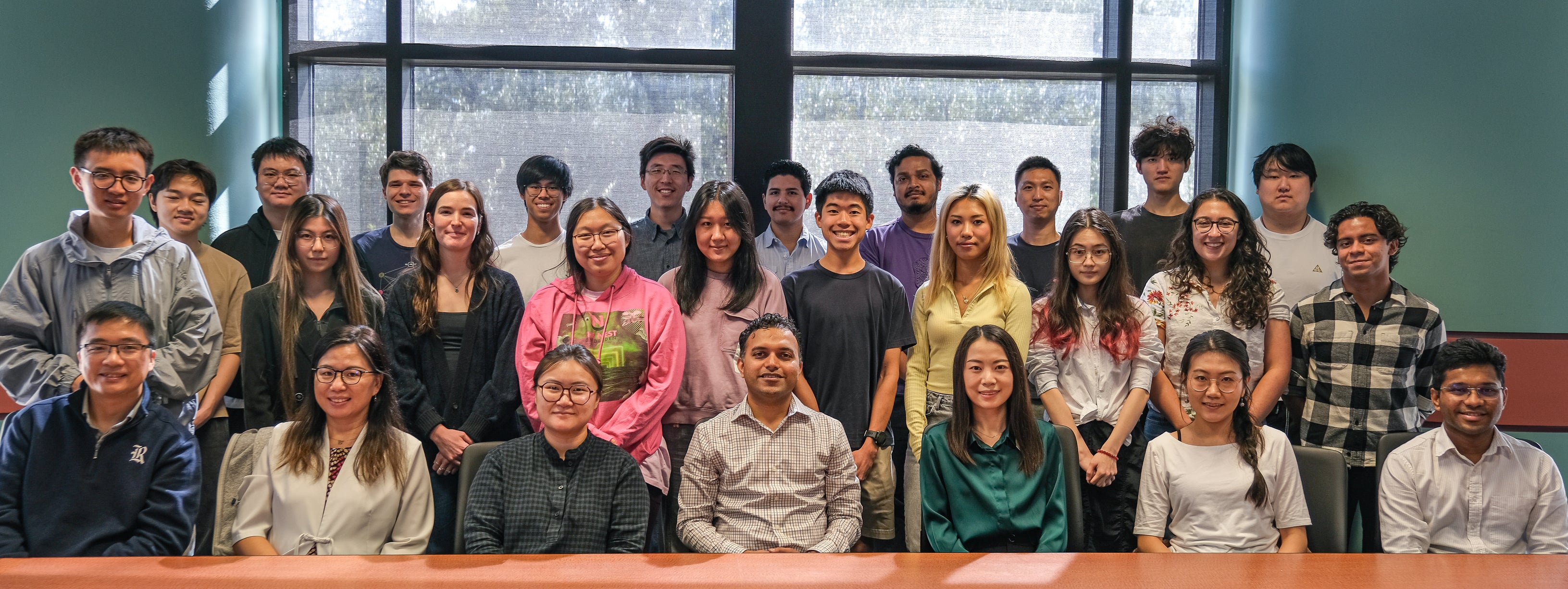
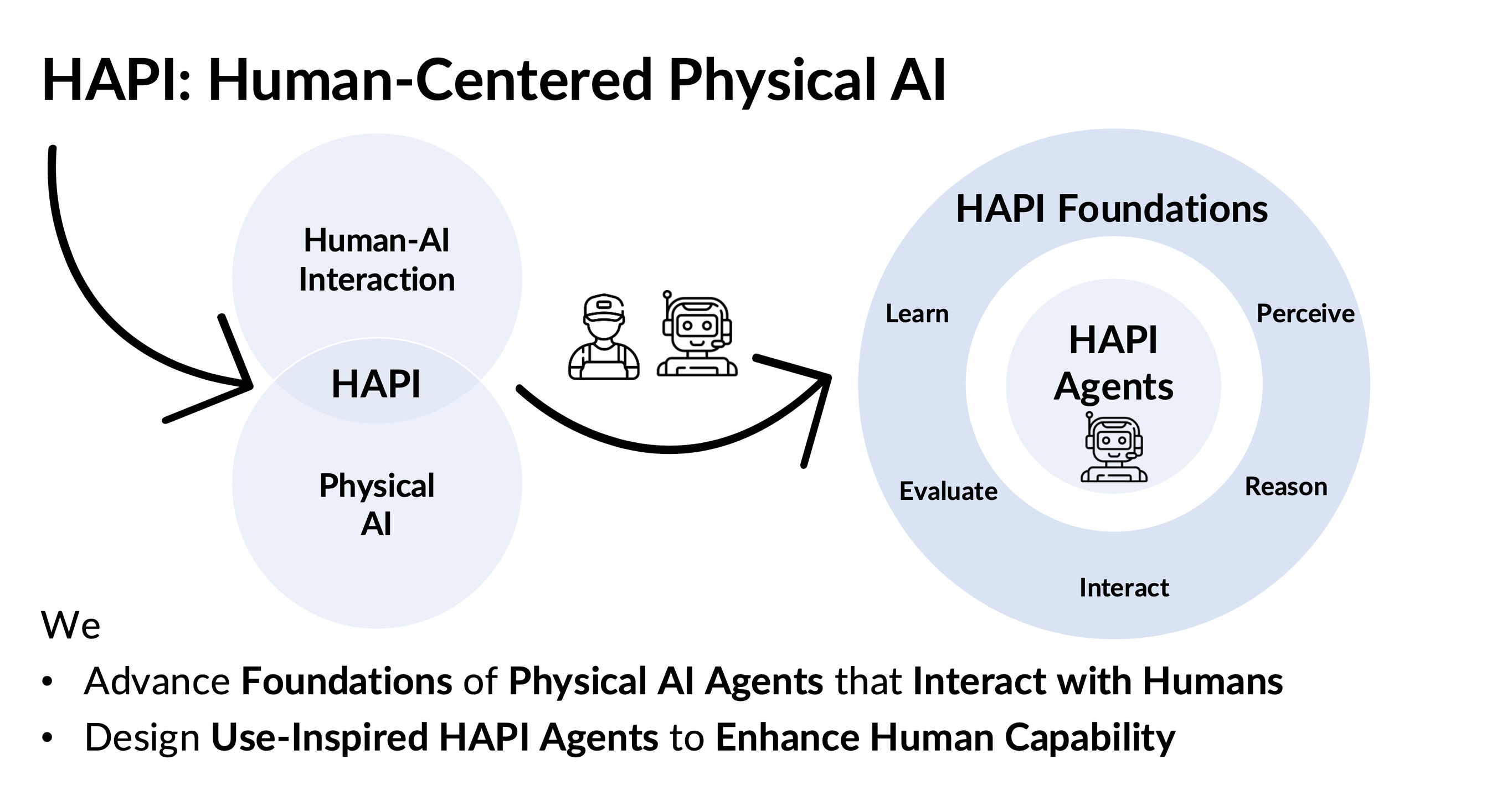
The Human-Centered Artificial Physical Intelligence (HAPI) cluster advances foundational research for physical AI agents, such as robotic assistants and intelligent tutors, that interact directly with humans—prioritizing responsible design, safety, user alignment and evaluation to enhance human capability. Their interdisciplinary approach integrates reasoning methods such as reinforcement learning and task planning; formal methods and benchmarking tools to ensure safety and correctness; explainability and interaction design to support interpretable behavior; and human-in-the-loop evaluation frameworks from psychological sciences to ensure that technical development remains grounded in human needs.
Cluster Members
- PI: Vaibhav Unhelkar (CS)
- Co-Is: Hanjie Chen (CS), Tianjun Sun (Psych), Moshe Vardi (CS), Jing Chen (Psych)
- Associates: Lydia Kavraki (CS), Vicente Ordonez Roman (CS)
-
Research Vision
-
Long-Term Goal: As AI becomes increasingly capable, it is also entering the physical world and engaging directly with humans. These physical AI systems are poised to transform key focus areas outlined in the Momentous strategic plan: Education, Urban Communities, and Health, and will play a central role in shaping these domains. For example, HAPI members are developing Intelligent Embodied Tutors to enable personalized workforce training. In disaster response, robotic assistants are already being deployed to support emergency operations and help build more resilient urban communities. In healthcare, smart prosthetics to surgical robots are helping improve the quality of care and patient outcomes.
Across these domains, physical AI systems hold significant promise for enhancing both human productivity and well-being. However, we contend that realizing this potential depends critically on a deliberate, human-centered approach to their development and deployment. Without such an Responsible AI approach, these systems may fail to meet user needs or worse, cause unintended harm. To address this challenge, we must—
- systematically study how humans and physical AI systems interact; and
- develop enabling solutions that enhance safety and e!ectiveness of these interactions.
The HAPI cluster pursues this research agenda by advancing foundational research in AI and human-centered computing. More specifically, HAPI focuses on human-centered aspects in the lifecycle of physical AI systems, spanning their—
- Design: How can physical AI systems be tailored or programmed by users?
- Use: How can physical AI systems be designed to support and enhance users?
- Evaluation: How can physical AI systems be e!ectively evaluated and audited over time? to ensure safety and alignment as they engage directly with humans in the physical world.
What is new in your approach and why do you think it will be successful?
To pursue these threads, HAPI brings together multidisciplinary faculty from AI, psychological sciences, robotics, and human-centered computing to enable the responsible design and deployment of AI systems that work with and for people. Our interdisciplinary approach integrates reasoning methods such as reinforcement learning and task planning; formal methods and benchmarking tools to ensure safety and correctness; explainability and interaction design to support interpretable behavior; and human-in-the-loop evaluation frameworks from psychological sciences to ensure that technical development remains grounded in human needs.
We believe Rice and, more specifically, our multidisciplinary team at the Ken Kennedy Institute is uniquely positioned to define and lead this important and emerging research area. Long-term, this cluster also aims to serve as a computational partner for synergistic, domain-specific research efforts taking place across the university. While there are prominent national e!orts in human- centered AI (e.g., Stanford HAI and Berkeley CHAI), their scope is broader and does not focus specifically on physical intelligence. Conversely, e!orts in physical or embodied AI (e.g., the GRASP Lab at UPenn) emphasize autonomy and control but do not prioritize human-centered aspects. By leveraging multidisciplinary expertise of our team and placing human-centeredness at the core of physical AI development, we have a unique opportunity to shape and lead this emerging field.