
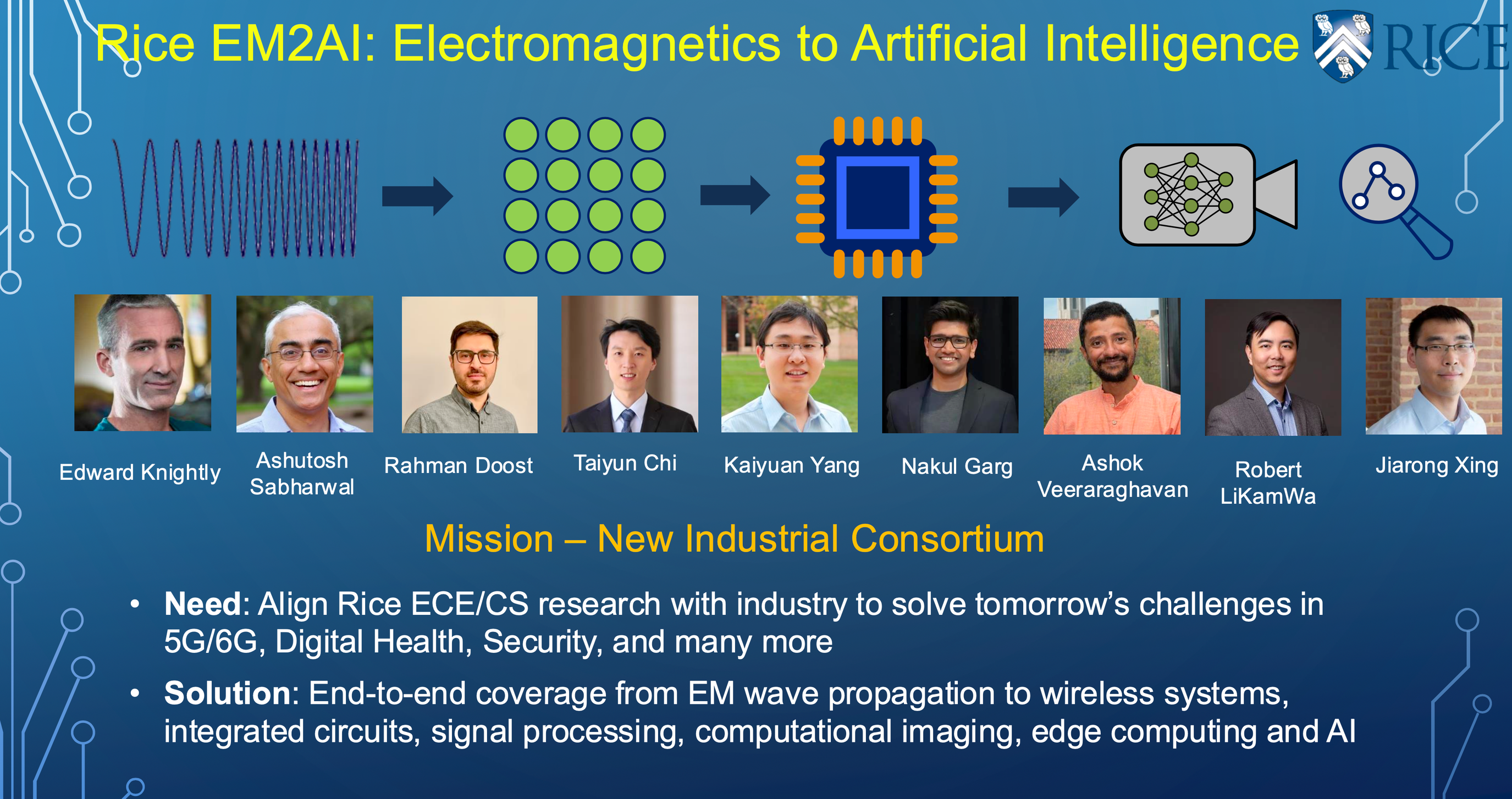
The Electromagnetics to Artificial Intelligence (EM2AI) cluster aims to holistically connect modern AI methods and physical systems—envisioning future systems as an end-to-end intelligent stack, spanning electromagnetic waveforms, analog and digital hardware, communication, sensing, computation, and human interaction, with AI co-designing and optimizing each layer. This vision will position Rice as a global leader in 6G, digital health, security, defense, and beyond. The team covers every layer of the physical system stack, spanning electromagnetic wave propagation, hardware implementation, signal processing, mobile computing, and information rendering.
Cluster Members
- PI: Rahman Doost-Mohammady (ECE)
- Co-Is: Taiyun Chi (ECE),Edward Knightly (ECE), Robert LiKamWa (ECE), Ashutosh Sabharwal (ECE),
- Associates: Nakul Garg (ECE), Ashok Veeraraghavan (ECE), Kaiyuan Yang (ECE), Jiarong Xing (CS)
-
Research Vision
-
The EM2AI cluster aims to holistically connect modern AI methods and physical systems. Traditionally, physical systems have been developed in a modular, partitioned way, where different layers of the system (such as antennas, circuits, software, protocols, data processing, and user interaction) are designed independently and often optimized in isolation. This vertical abstraction simplifies the overall system design and has served the industry well for decades, allowing human domain experts to focus on individual layers based on their specialization. However, this approach is fundamentally constrained: it prevents joint optimization across layers, often leading to sub-optimal overall system performance. Additionally, the design process within each layer still relies on human-crafted rules and heuristics for design and optimization, particularly in hardware implementation. These manual design flows are slow, require deep expertise, and are not easily scalable, resulting in a significant productivity bottleneck. Holistic cross-layer optimization has been an aspiration for decades, but in practice, it was intractable to implement before the AI era, due to the vast search space in the system design and significant modeling complexity. The AI era has brought new tools, such as data-driven analysis, surrogate modeling, and reinforcement learning, and we believe these tools will make previously intractable cross-layer optimization solvable.
We envision future systems as an end-to-end intelligent stack, spanning electromagnetic waveforms, analog and digital hardware, communication, sensing, computation, and human interaction, with AI co-designing and optimizing each layer. This vision will position Rice as a global leader in 6G, digital health, defense, and beyond.
The second year of this group will be a renewal of the EM2AI (electromagnetics to Intelligence) cluster, focusing on advancing the future of physical systems for communications, sensing, and imaging applications. Our interdisciplinary effort is driven by the strong, existing collaboration among Rice faculty working across these diverse areas. We have assembled a team that covers every layer of the physical system stack, spanning electromagnetic wave propagation, hardware implementation, signal processing, mobile computing, and information rendering.
The Teams’ Strengths and Key Differentiators: Our approach is built upon the following three key pillars.
(1) End-to-end system co-design: The cluster includes a uniquely qualified team for end-to-end physical system development, covering all critical layers in the full system stack, including EM propagation and wireless networking (Sabharwal, Knightly, Doost-Mohammady), hardware electronics (Chi), devices (Yang), Sensing and Imaging (Garg, Veeraraghavan), AI systems (Xing), and information rendering (LiKamWa). More importantly, our faculty have already collaborated on multiple projects that build the trust and alignment necessary for coherent system-level innovation.
(2) Build an industry ecosystem: Our faculty members have already been working with industry partners such as Intel, Samsung, Cisco, Nvidia, GlobalFoundries, Qualcomm, just to name a few. We have seen growing interest in the industry in new sensing and imaging applications that bridge EM and AI, especially for edge devices. Other than this research cluster affiliated with the Ken Kennedy Institute, we are establishing a new EM2AI industry consortium to foster deeper, more consistent engagement with the industry. At a time when federal support becomes uncertain, industry engagement is more critical than ever.
(3) Proven record of building systems at scale: Our team has a strong track record of building practical wireless systems and translating impactful technologies. Sabharwal’s WARP, launched in 2006, became a global open-source testbed for wireless research and gave rise to Mango Communications, a Rice spin-off. His current Houdini project is creating the world’s first fully programmable and observable multi-band SDR for communications and imaging to test diverse ideas and concepts, ranging from low-level hardware to all the way to novel applications. Similarly, Knightly led one of the nation’s first city-scale wireless deployments in Houston, delivering Wi-Fi access to underserved communities. These successes reflect the kind of translational, high-impact system research that we envision through the new EM2AI cluster.
Impact: Success in EM2AI will position Rice as a national leader in the future of physical system design. Our success could reshape how these systems will be designed in the future, not as stacks of independent blocks but as co-designed systems where AI enhances every layer from electromagnetics to information extraction and rendering. This will directly benefit domains such as 6G and enable new wireless sensing and imaging capabilities through wireless infrastructure and at the edge. All these efforts will position Rice EM2AI as a national leader in this space.