
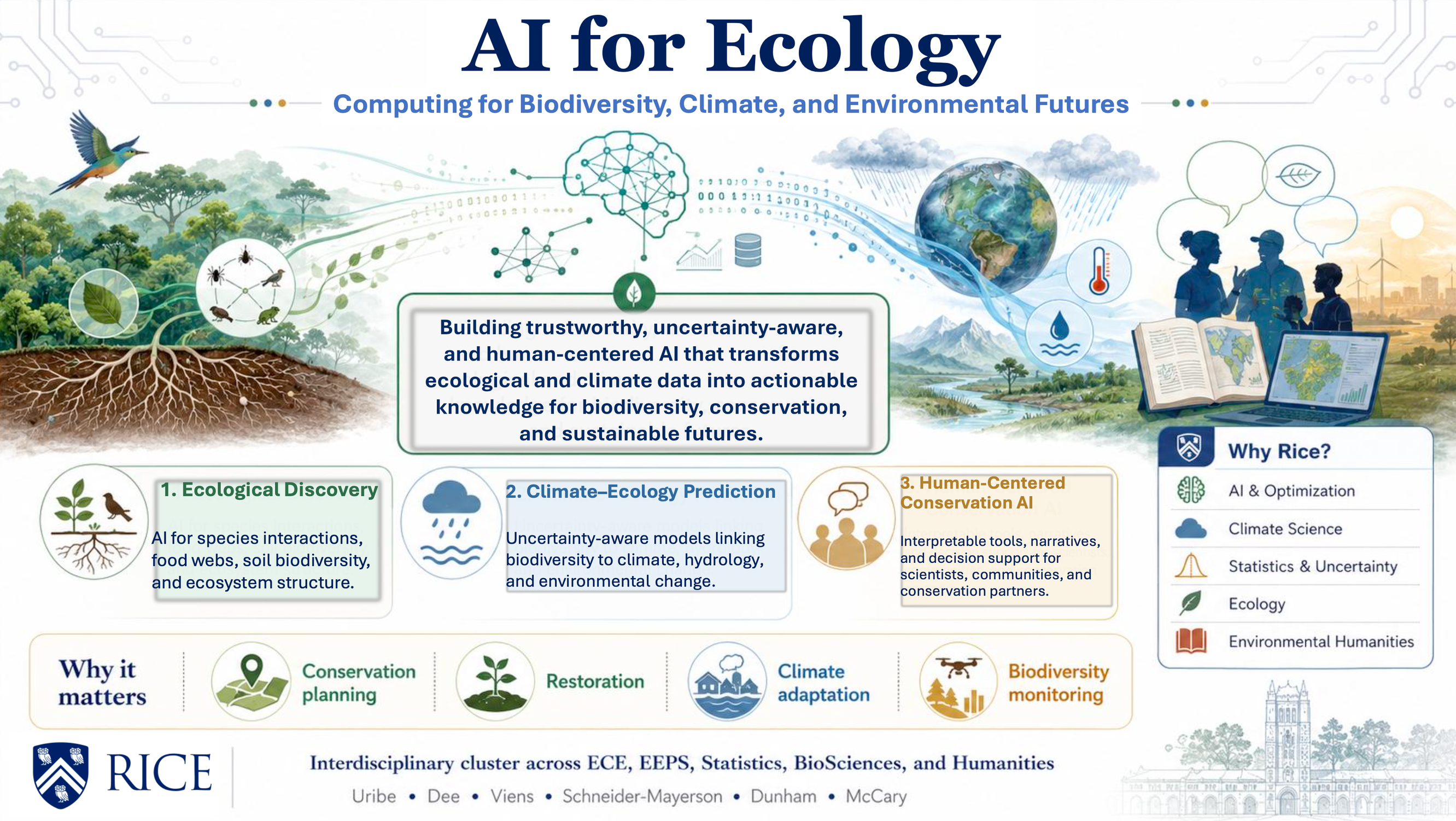
This cluster focuses on AI for Ecology: Computing for Biodiversity, Climate, and Environmental Futures. They work on building trustworthy and human-centered AI for understanding and responding to ecological change. The team will create AI tools and models to transform fragmented ecological and climate data into actionable knowledge for species discovery, biodiversity monitoring, conservation planning, climate adaptation and hydrology, and environmental resilience and restoration. This breadth of the cluster gives Rice a unique opportunity to define AI for Ecology as mathematically rigorous, climate-aware, ecologically grounded, statistically principled, and socially meaningful.
Cluster Members
- PI: Cesar Uribe (ECE)
- Co-Is: Sylvia Dee (EEPS) Frederi Viens (STATS) Matthew Schneider-Mayerson (English and Creative Writing)
- Associates: Amy Dunham (BioSciences), Matthew McCary (BioSciences)
-
Research Vision
-
Long-term research objectives: We will establish Rice as a leader in trustworthy, uncertainty-aware, and human-centered AI for understanding and responding to ecological change. Biodiversity loss, climate disruption, habitat fragmentation, soil degradation, and changing species interactions are defining scientific and societal challenges. Yet the relevant data are heterogeneous, incomplete, and distributed across scales, including species observations, food webs, acoustic and image data, climate records, hydrological reconstructions, soil measurements, and cultural narratives of environmental risk. Our long-term objective is to build a new AI and Computing capability at Rice that transforms these fragmented data streams into rigorous, interpretable, and actionable knowledge for ecology, conservation, climate resilience, and sustainable futures.
The cluster will pursue three interconnected objectives. First, we will develop AI methods for ecological discovery, emphasizing graph learning, optimal transport, distributed optimization, and network representations of species interactions, food webs, soil biodiversity, and ecosystem structure. This thrust builds on Cesar A. Uribe’s expertise in distributed learning, optimization, network science, and computational optimal transport. Second, we will create uncertainty-aware models for climate–ecology prediction, linking ecological dynamics to climate variability, hydrology, and environmental stressors. This thrust draws on Sylvia Dee’s expertise in atmospheric modeling, water-isotope physics, and climate-data-model comparison, as well as Frederi Viens’ expertise in probability, stochastic processes, statistics, and risk modeling. Third, we will develop human-centered AI tools that translate ecological and climate predictions into interpretable explanations, narratives, and decision-relevant outputs for scientists, communities, conservation organizations, and policy-facing partners. This thrust is grounded in Matthew Schneider-Mayerson’s work on environmental literature, media, and empirical ecocriticism.
Impact: Achieving these objectives will change how AI is used in ecology: from black-box prediction toward tools that explain ecological structure, quantify uncertainty, integrate climate drivers, and communicate results responsibly. Scientifically, the cluster will create computational foundations for learning from ecological networks, forecasting biodiversity responses under climate stress, and connecting aboveground and belowground ecosystem processes. Practically, it will support conservation planning, restoration, climate adaptation, and biodiversity monitoring through tools that are transparent, trustworthy, and transferable across ecosystems. The cluster will also train students and postdocs who can work across AI, statistics, climate science, ecology, and environmental humanities.
The strengths of our team: Our team unites the full chain of expertise required for AI for Ecology: mathematical and computational foundations, climate and hydrological science, uncertainty quantification, ecological domain knowledge, and human-centered interpretation. Amy Dunham brings expertise in tropical community ecology, species interactions, conservation management, defauna- tion, invasion, and habitat fragmentation. Matthew McCary contributes expertise in soil biodiversity, food-web dynamics, ecosystem functioning, disturbance, restoration, and global change. Together with Uribe, Dee, Viens, and Schneider-Mayerson, they make this cluster distinctive among AI-for- environment efforts worldwide. While many groups focus on AI algorithms, ecological field science, climate modeling, or science communication separately, our cluster integrates all four. This breadth gives Rice a unique opportunity to define AI for Ecology as mathematically rigorous, climate-aware, ecologically grounded, statistically principled, and socially meaningful.