
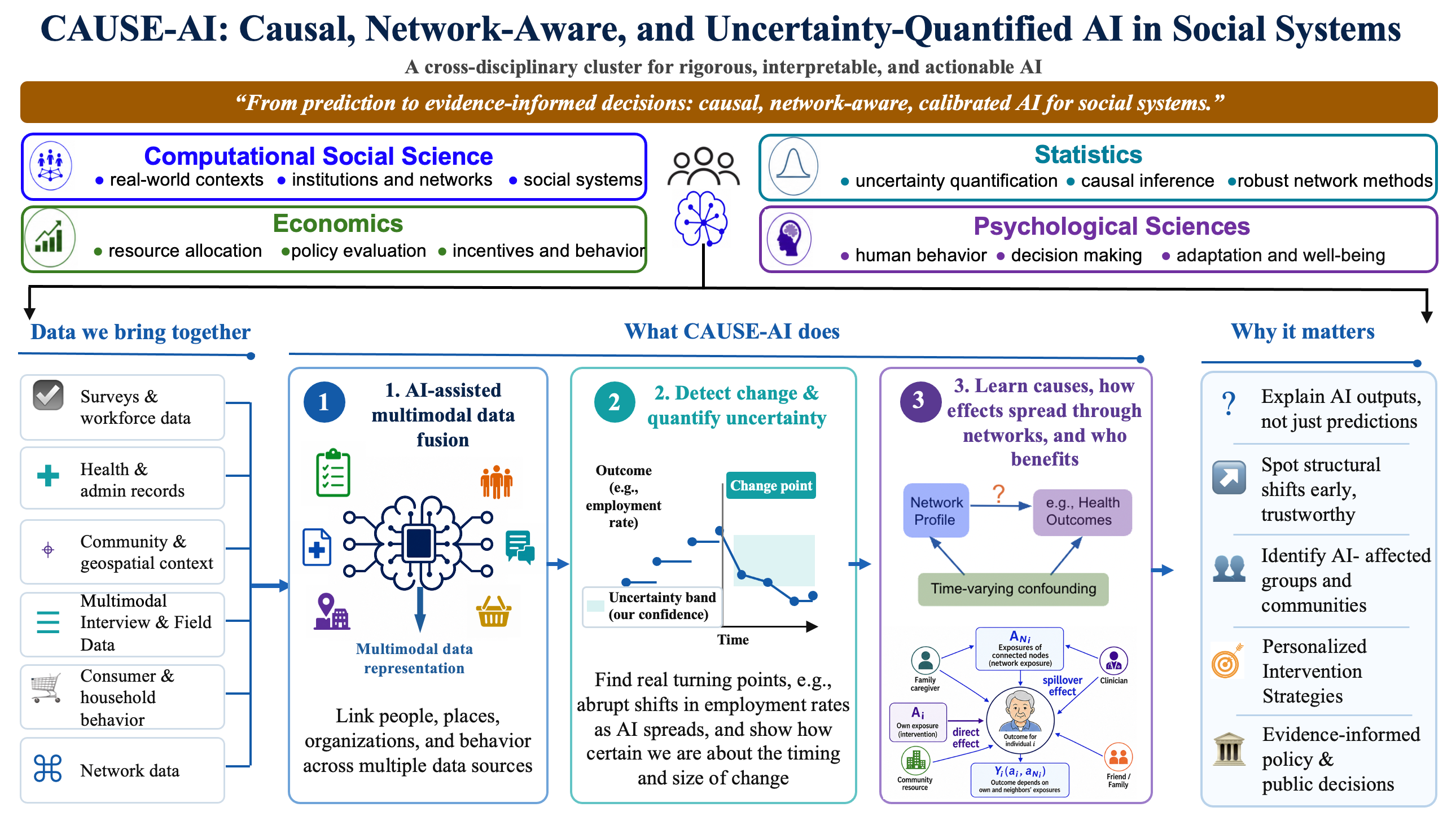
The Causal, Network-Aware, and Uncertainty-Quantified AI in Social Systems (CAUSE-AI) team forms a cross-disciplinary cluster for rigorous, interpretable, and actionable AI to transform data from black-box prediction to evidence-informed decisions in complex social systems. Their work combines computational social science, statistics, economics, and psychological sciences—using AI grounded in statistical inference to detect change and explain social dynamics for policy and public consequence. CAUSE-AI will help decision-makers distinguish structural shifts from noise, identify affected groups, and quantify uncertainty in the timing and magnitude of change.
Cluster Members
- PI: Corey Abramson (Sociology)
- Co-Is: Judy Huixia Wang (Statistics), Jiaqi Li (Statistics), Guillaume Pouliot (Economics), Cindy Zhang (Statistics)
- Associates: Jing Chen (Psych), Elizabeth Roberto (Sociology), Tianjun Sun (Psych) , Hannah Ballard (Kinder)
-
Research Vision
-
Causal, Network-Aware, and Uncertainty-Quantified AI in Social Systems (CAUSE-AI): Artificial Intelligence (AI) increasingly shapes decisions about education, employment, public administration, science, human health, transportation, and online platforms. Yet contemporary AI systems remain better at prediction than understanding, which limits their value for high- stakes decisions. In complex social systems populated by people who respond to the same models used to describe their behavior, prediction alone is insufficient for explanation. Decision- makers and scientists need causal effects, mechanisms, counterfactual outcomes, network spillovers, and quantified uncertainty in model outputs themselves.
To meet this need, this cluster will advance causal, network-aware, and uncertainty-quantified AI for complex social systems. The central shift is from black-box prediction to AI grounded in contemporary statistical inference: identification of intervention effects, recovery of the generative processes and behavioral mechanisms that produce observed outcomes, modeling of interdependence and heterogeneity across populations, integration of multi-level data, detection of path dependence and change points, and calibrated uncertainty in model outputs.
The aim is to reduce error in both AI systems and the evidence base they inform. Drawing on contemporary statistics and the social and data sciences, including sociology, economics, and psychology, the cluster will build a cross-disciplinary team that combines mathematical, computational, and substantive knowledge to explain complex social dynamics in domains of policy and public consequence, and to strengthen the foundational tools that produce credible evidence for decisions. A key application will be identifying structural changes in social systems, since AI adoption may produce abrupt shifts in employment, health care delivery, and online interaction, with consequences distributed unevenly across occupations, regions, or demographic groups. CAUSE-AI will help decision-makers distinguish structural shifts from noise, identify affected groups, and quantify uncertainty in the timing and magnitude of change.
Initial Application Domains
- Work and Technology
- Place and the Environment
- Health and Aging
- Social and Information Networks
Distinctive Contribution: CAUSE-AI builds on Rice’s existing strengths in trustworthy AI and scientific machine learning, extending them into decision-relevant AI for complex social systems and communities. The interdisciplinary team will position Rice to lead in an emerging area of national importance and to compete for large-scale external funding on policy-relevant AI.