
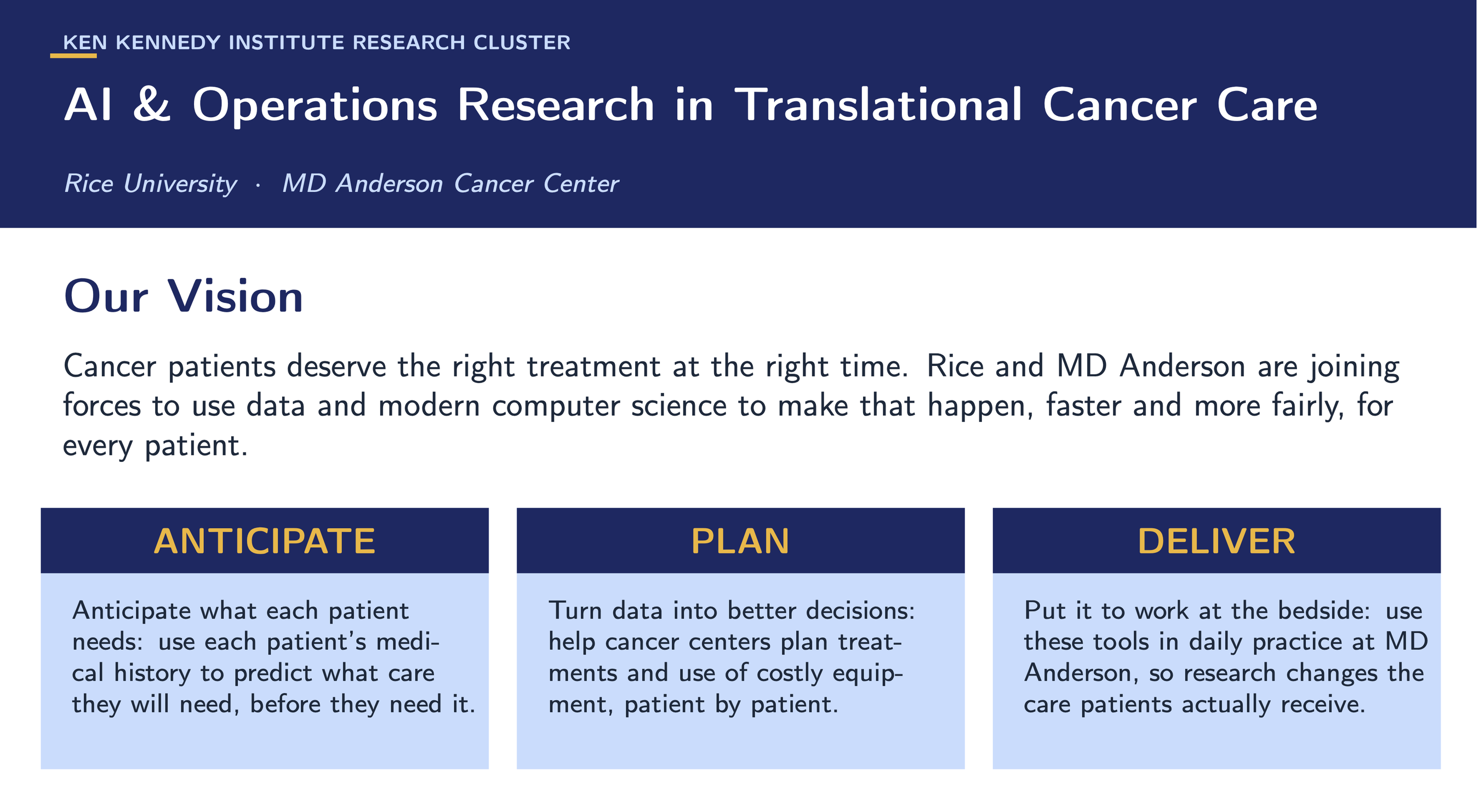
This working group focuses on AI and Operations Research in Translational Cancer Care. They aim to establish Rice as the leading academic center for the development and translation of operations research methods for cancer care, anchored by a deep and sustained partnership with Texas Medical Center. The group brings together experts from Rice University and MD Anderson Cancer Center to use data and modern computer science to anticipate, plan, and deliver cancer patient needs faster and more fairly—working to allocate scarce diagnostic capacity across a multi-clinic network for optimal care delivery.
Cluster Members
- PI: Andrew Schaefer (CMOR)
- Co-Is: Tolga Tezcan (Business), Sebastian Perez-Salazar (CMOR), Suleyman Kerimov (Business)
-
Research Vision
-
The long-term objective of this cluster is to establish Rice as the leading academic center for the de- velopment and translation of operations research (OR) methods for cancer care, anchored by a deep and sustained partnership with Texas Medical Center (TMC), including MD Anderson Cancer Center (MDACC) and Baylor College of Medicine (BCM). Modern cancer treatment is a sequence of high- dimensional, uncertainty-laden decisions, such as which modalities to combine, when to adapt a clinical trial, and how to allocate scarce diagnostic capacity across a multi-clinic network, all made under tight op- erational constraints. Progress requires methods that are state-of-the-art in OR and AI/ML, co-developed with clinicians and cancer-center leadership to ensure translational impact.
The cluster pursues this integration along three coupled axes. Prediction: ML and LLM-based mod- els that estimate patient-level clinical trajectories from structured EHR data and unstructured clinical notes. Decision: stochastic and online optimization for patient routing, multi-clinic capacity allocation, adaptive trial design, and multi-modality treatment planning that consume these predictions and pro- duce actionable recommendations under realistic uncertainty. Translation: embedding these methods into MDACC’s operational and strategic decision-making, so that methodological advances become op- erational practice rather than stopping at publication. Over time, this translational dimension will give Rice structured access to real MDACC operational and clinical data, creating a virtuous loop between method development and bedside evidence.
A defining emphasis of this cluster is optimal cancer care delivery, namely the operational and strategic decisions that determine whether the right patient receives the right treatment at the right time. Cancer centers face di!cult choices in how to best deliver care: appointment, surgery, and personnel scheduling, ICU and recovery management, and patient routing across multi-site networks.
Impact: The cluster will accelerate the deployment of AI and OR methods in cancer care; improve the timeliness, equity, and e!ciency of cancer diagnosis, treatment, and care delivery; train PhD students and postdocs at the AI-optimization-medicine interface; and build a durable pipeline of externally funded research at Rice. It supports the Ken Kennedy Institute’s “AI & Computing for Innovations in Health” priority and aligns with Rice’s Momentous premier-research pillars.
Team Strengths and Distinctiveness: Each member of the team brings a distinct strength, and the combination makes the cluster viable. Schaefer (PI) is a Fellow of INFORMS and IISE and an established NIH investigator focused on stochastic optimization for medical decision-making, including cancer treatment planning; he provides the direct pipeline between optimization methodology and clinical deci- sion problems. Tezcan is an NSF CAREER awardee with a record of NSF-funded research on stochastic modeling for large-scale service systems and healthcare operations, and his expertise anchors the cluster’s capacity, scheduling, patient-flow, and care-delivery work. Perez-Salazar’s research on online and adaptive optimization under uncertainty speaks directly to adaptive clinical trials and treatment planning, where decisions must be made sequentially as information arrives. Kerimov’s work on online selection under disruption addresses exactly the kind of uncertainty, including missed appointments, equipment breakdowns, and demand surges, that dominates real cancer operations. These four cover clinical-facing stochastic optimization, prediction-aware capacity and care-delivery modeling, adaptive decision theory, and robust online methods; their joint presence at Rice is uncommon nationally.
We distinguish ourselves in three ways. First, proximity and an established working relationship with MDACC and BCM. Second, the range of methodological expertise on a single team, spanning rigorous AI/ML, stochastic optimization, online decision theory, and operations practice; peer e”orts typically have one or two. Third, concrete pilot work already in progress with MDACC on breast cancer diagnostic scheduling, multi-clinic patient routing, and biopsy-capacity allocation under stochastic demand, giving the cluster preliminary results rather than a cold start.