
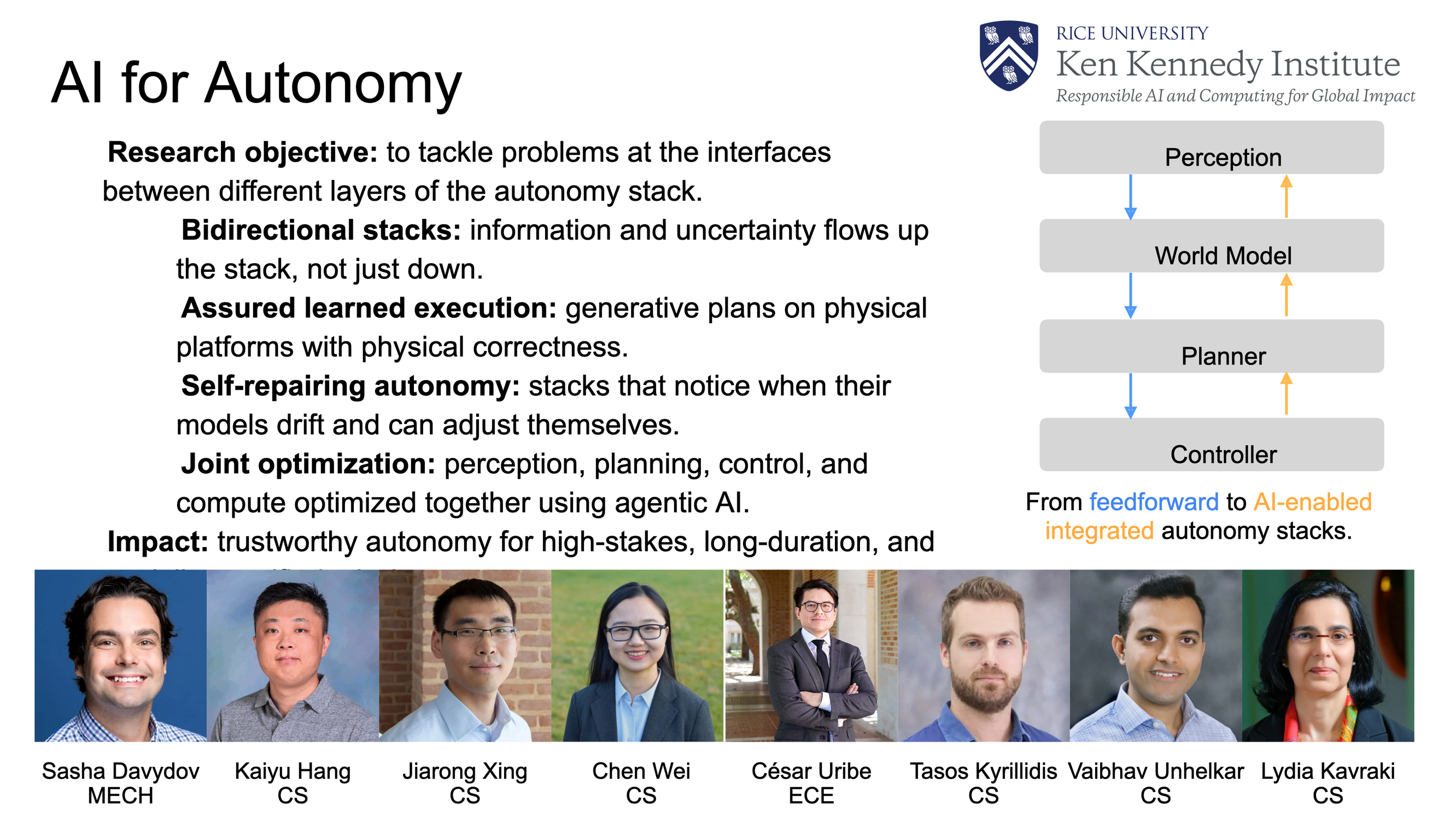
The goal of the AI for Autonomy cluster is to position Rice University as an academic leader in developing fundamental methods for autonomous systems and robotics. The work will tackle failures at the interfaces of autonomy stacks by developing bidirectional information flow assured learned execution on physical platforms, and joint optimization—aiming to create trustworthy, self-repairing autonomous systems that can perceive, plan, control, and compute using agentic AI.
Cluster Members
- PI: Sasha Davydov (MECH)
- Co-Is: Kaiyu Hang (CS), Jiarong Xing (CS)
- Associates: Chen Wei (CS), Cesar Uribe (ECE), Tasos Kyrillidis (CS), Vaibhav Unhelkar (CS), and Lydia Kavraki (CS)
-
Research Vision
-
Our long-term vision is to position Rice University as an academic leader in developing fundamental methods for autonomous systems and robotics. The challenge that organizes our work is the follow- ing: the layers of an autonomy stack do not talk to each other in the ways they need to. The conventional architecture based on perception feeding a world model, feeding a planner, feeding a controller is fundamentally feedforward, and decades of research have refined each layer in isolation. Yet real autonomous systems fail at the interfaces between these layers, and these failures share a common structure: information that should propagate between layers does not flow at all. A planner generates a trajectory that is dynamically infeasible, and the controller has no way to execute the plan. A con- troller discovers, through repeated low-level failures, that the environment is not as the world model represents it, but no mechanism exists to push that knowledge upward. Underlying these failures is a deeper assumption we believe needs revisiting: that software executes in a sandbox isolated from the physical world, with the environment treated as peripheral input. In autonomous systems the environment is part of the computational substrate, and correctness must be defined with respect to physical manifestation (e.g., gravity, friction, energy) rather than logical output alone. These are open research problems that sit precisely at the interfaces our individual disciplines do not own.
Long-term research objectives. We will pursue four objectives that aim to address these research challenges. First, autonomy stacks in which uncertainty and infeasibility propagate bidirectionally across layers, replacing the feedforward pipeline with a genuinely closed-loop architecture. Second, principled methods for executing generative and learned plans under feasibility and safety guarantees, so that the expressiveness of modern AI can be deployed on physical platforms without sacrificing assurance, where assurance is grounded in physical correctness rather than logical correctness alone. Third, autonomy stacks that monitor and repair themselves over long horizons, recognizing when their world models, policies, or cost functions have drifted from physical reality and correcting them with minimal human intervention. Fourth, agentic and computational architectures that treat the allocation of perception, planning, control, and compute as a single joint optimization, rather than as separately engineered subsystems.
Impact. Success on these objectives reshapes what autonomous systems can be trusted to do, and positions Rice as the institutional home of the research that makes it possible. Stacks with bidirectional information flow become less opaque to the humans who supervise them, scaling oversight to systems too numerous or too remote for continuous monitoring. Stacks that execute generative plans under for- mal guarantees unlock high-stakes, dynamic, partially-specified missions that neither classical robotics nor pure learning currently serves. Stacks that monitor and repair themselves become deployable in environments where human contact is intermittent. Across these directions, the cumulative impact is autonomous systems that earn trust by behaving in measurable, monitored, and recoverable ways, and a Rice cluster that defined how the field got there.
The strengths of our team. Our interdisciplinary team spans expertise across different layers of the autonomy stack and, critically, the interfaces between them. Our cluster brings together individuals with fundamental expertise in: robotics (Hang, Unhelkar, Kavraki), planning (Hang, Kavraki), con- trol (Davydov, Uribe), algorithms (Kyrillidis), optimization (Davydov, Uribe, Kyrillidis), learning (all members), perception (Wei), and optimization of computing resources (Xing). What distinguishes our team is not the breadth of expertise alone but its alignment. The interface problems we have identified are owned by people in this cluster rather than scattered across institutions that do not coordinate.