
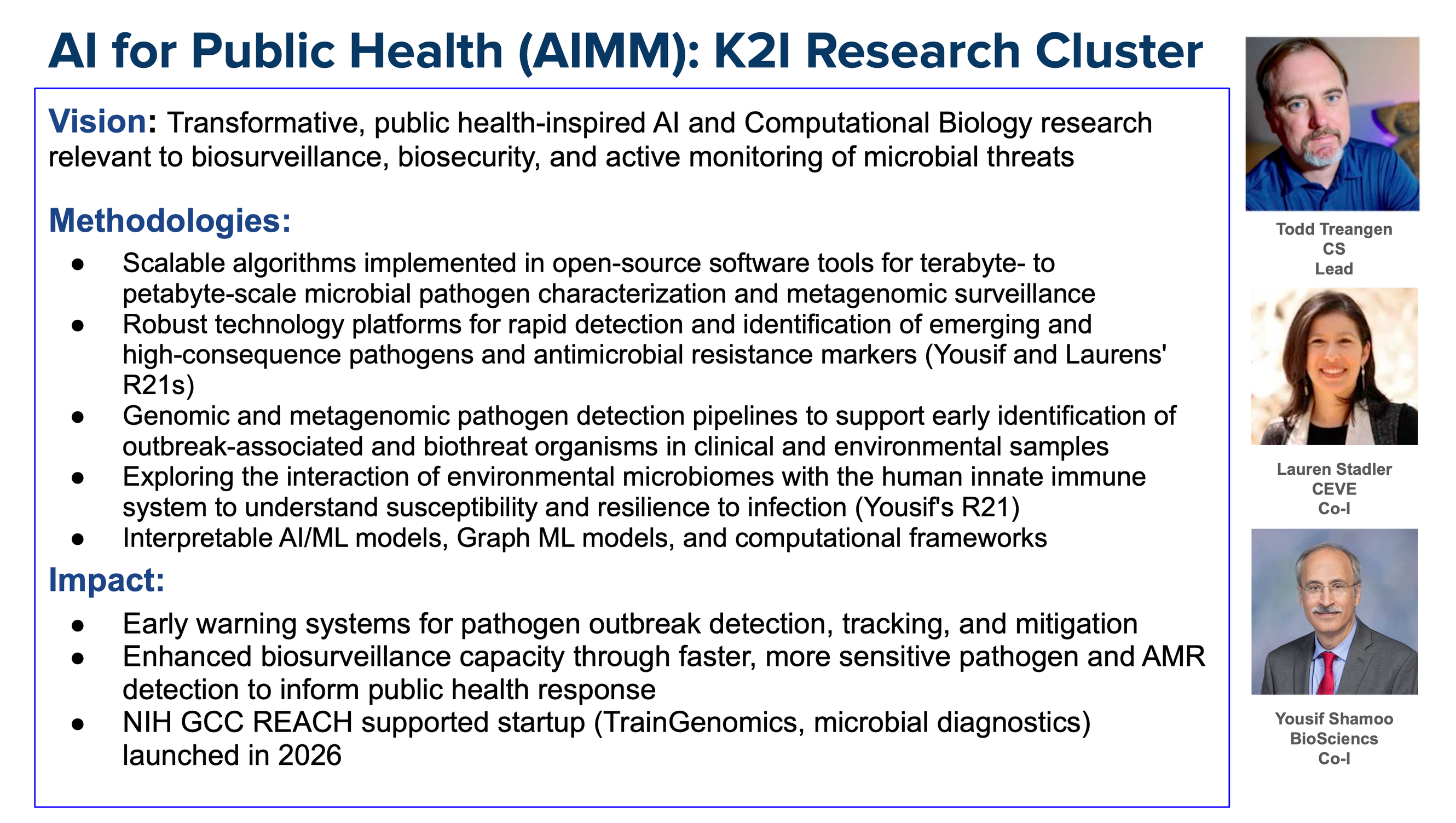
The AI for Microbial Monitoring (AIMM) cluster works toward transformative, public health-inspired AI and computational biology research relevant to biosurveillance, biosecurity, and active monitoring of microbial threats. They focus on scalable AI for early pathogen detection, antimicrobial-resistance tracking, wastewater-based epidemiology, and outbreak response. They use robust technology platforms, open-source software, pathogen detection pipelines, and interpretable machine learning models and computational frameworks to enhance biosurveillance capacity and advance early warning systems for pathogen outbreak detection, tracking, and mitigation.
Cluster Members
- PI: Todd Treangen (CS)
- Co-Is: Yousif Shamoo (BioSciences), Lauren Stadler (CEVE)
- Associates: Luay Nakhleh (CS), Lydia Kavraki (CS), Ivan Coluzza (CHEM), Linna An (BioSciences), Cameron Glasscock (Biosciences), Santiago Segarra (ECE), Vicky Yao (CS)
-
Research Vision
-
Since the arrival of omics data, scientists have applied computational techniques to research questions in the biosciences, such as monitoring infectious diseases, predicting genes relevant to human health and disease (e.g., cancer and Alzheimer’s), and characterizing microbiomes (human host-associated, wastewater, etc.). Today, the juxtaposition of petabyte-scale omics datasets, improvements in computational hardware (CPUs and GPUs), and rapid advances in AI/ML have set the stage for a transformative new paradigm in AI2Health research. For example, the recent success of AlphaFold in protein structure prediction marked an important milestone for the community, highlighting the potential of machine learning approaches combined with gold-standard training datasets to advance fundamental biological questions. Our long-term vision for our Ken Kennedy Institute-supported research cluster is to build custom-fit, biologically informed AI/ML approaches to form a foundational toolkit enabling the exploration of new frontiers in AI and Computing for Biology and Health; deploy these tools to the public domain; and form targeted collaborations to refine predictions for specific biomedical and public health questions.
2026 Strategic Refocus:
Building on two years of foundational work, the AI2Health cluster will refocus its research agenda around two integrated, high-impact thrusts that map our methodological strengths onto areas of greatest societal need. Thrust 1: Clinical Omics and Human Health (Yao and Segarra), and Thrust 2: Biosecurity, Biosurveillance, and Public Health (Segarra and Treangen).
The cluster led by Todd Treangen will focus on Thrust 2 to advance scalable AI for pathogen detection, antimicrobial-resistance tracking, wastewater-based epidemiology, and outbreak response. Two new AI2Health associates greatly strengthen this thrust: Dr. Yousif Shamoo (Ralph and Dorothy Looney Professor, BioSciences) brings world-class expertise in antimicrobial resistance and microbial evolution, providing experimental grounding for AI-driven AMR prediction; and Dr. Lauren Stadler (Associate Professor, Civil and Environmental Engineering) brings Houston’s leading wastewater-surveillance program, with expertise in infectious-disease surveillance, modeling, and engineering actionable public health solutions from omics data.