
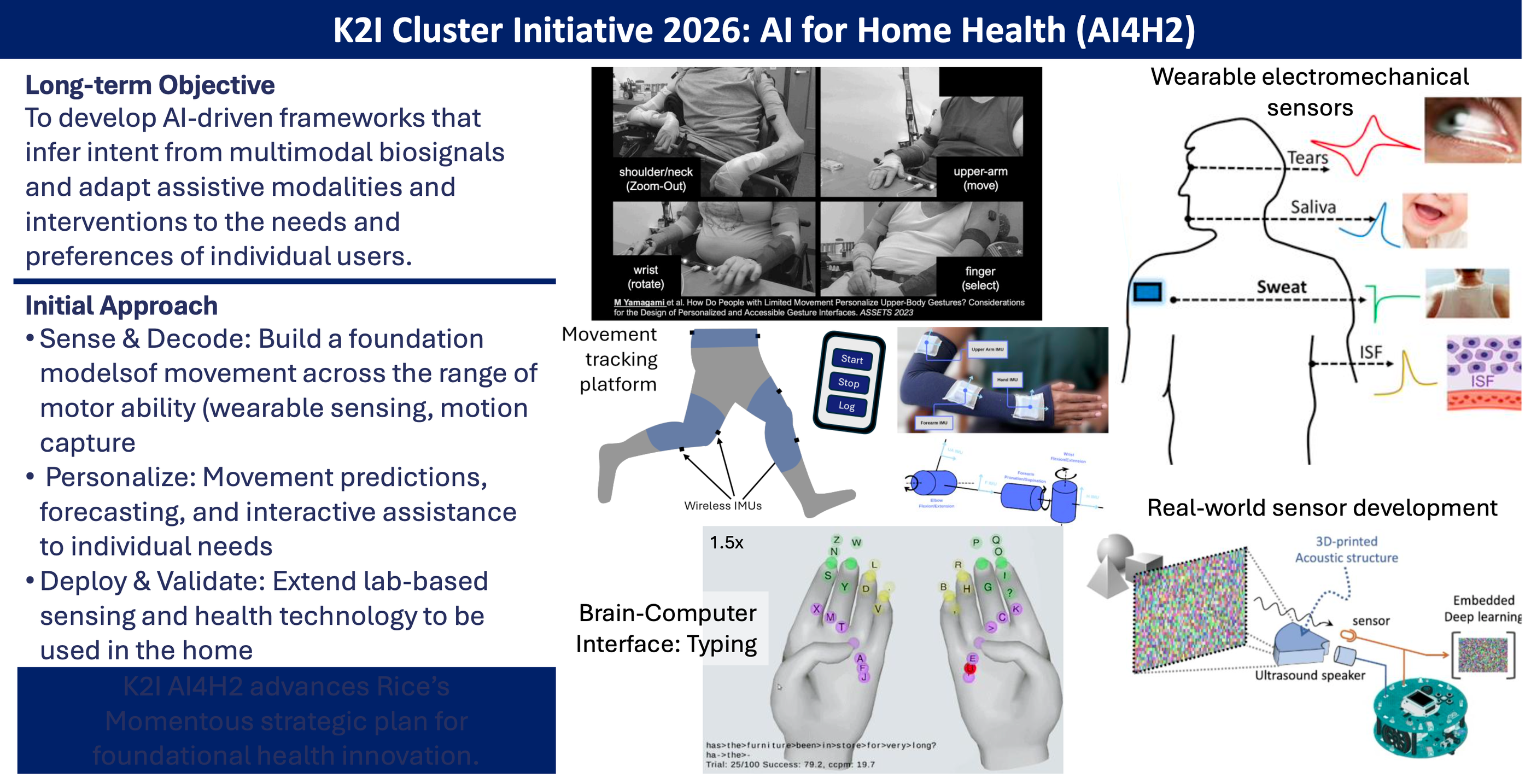
The AI for Home Health (AI4H2) group works at the intersection of AI, digital health, neuroengineering, wearable sensing, wireless systems, and robotics to create AI-mediated home health technologies across the ability spectrum. They aim to develop AI-driven frameworks that infer intent from multimodal biosignals and adapt assistive modalities and interventions to the needs and preferences of individual users with motor disabilities—positioning Rice as a leader in closed-loop, AI-driven assistive neurotechnology.
Cluster Members
- PI: Momona Yamagami (ECE)
- Co-Is: Keya Ghonasgi (MECH), Nishal Shah (ECE), Juliane Sempionatto (ECE)
- Associates: Marcia O’Malley (MECH), Ashutosh Sabharwal (ECE), Ashok Veeraghavan (ECE), Behnaam Aazhang (ECE), Jacob Robinson (ECE)
-
Research Vision
-
Long-Term Research Objectives: Advances in biosignal sensing are rapidly expanding what is measurable outside the clinic. Wearables, implantables, radio acoustics, wireless sensing, camera-based systems, and other ambient sensors enable continuous, unobtrusive capture of physiological and behavioral health data through digital biomarkers related to kinematics, muscle and brain activity, and sweat-based electrochemical signatures of metabolic and biochemical states. The price and form factor of these new and emerging sensors support continuous health monitoring and AI-mediated assistive technologies in real-world settings outside the clinic. This K2I cluster brings together Rice faculty across departments and schools working at the intersection of AI, digital health, neuroengineering, wearable sensing, wireless systems, and robotics to create AI-mediated home health technologies across the ability spectrum. This cluster will broaden the scope of the Rice-Houston Methodist Digital Health Institute beyond Methodist and strengthen connections with other clinical collaborators at the Texas Medical Center.
An initial focus is to develop an AI-driven framework that infers movement intent from multimodal biosignals and adapts assistive interventions to the needs and preferences of individual users with motor disabilities. We will pursue this through three integrated aims: (1) building a foundation model that fuses signals across recording modalities — electromyography (EMG), electroencephalography (EEG), intracortical neural recordings, and novel wearable devices developed within our team — to robustly decode movement intent and other physiological and psychological factors associated with movement; (2) personalizing assistive interventions and motor imagery paradigms through a shared autonomy framework that blends expert AI control with real-time human input; and (3) translating these solutions into reliable, adaptive at-home care technologies validated with real-world patient populations. This initial focus on movement forms the first step toward our long-term vision of AI-driven healthcare in the home.
Impact: AI-mediated telemedicine is the next frontier of healthcare, supporting passive monitoring and assistive technologies throughout patients’ day-to-day lives. For example, over 15 million people experience stroke annually worldwide, and millions more live with incomplete SCI, ALS, or other upper-motor neuron disorders — populations that stand to benefit substantially from effective assistive technology. For individuals with complete paralysis, intracortical brain-computer interfaces (BCIs) have already demonstrated transformative potential for speech and communication. By enabling at-home use and personalized adaptation, we move beyond sparse clinical snapshots toward continuous, effective home monitoring and care that scales. This work directly advances Rice's Momentous initiative in health innovation and positions Rice as a national leader in closed-loop, AI-driven assistive neurotechnology.
Team Strengths: Rice’s collaborative environment and access to the Texas Medical Center provides unique and unparalled opportunities for engineers, social scientists, humanists, clinicians, and patients to come together to create the next generated AI-powered home health technologies. Our collaborative team covers diverse areas of research including digital health (Yamagami, Sempionatto), neuroengineering (Shah, Ghonasgi), and devices (Garg, Sempionatto) for various applications, including rehabilitation, assistive technologies, and next-generation wearable sensors. Our large team of associates will support our core team in statistical signal processing, interpretable machine learning, and distributed optimization (Li, Uribe, Kyrillidis, Segarra, Wang), as well as providing expertise and submitting impactful medium- and large-scale grant applications. No other group combines active clinical BCI trial access, rehabilitation robotics, and personalized AI methods under one collaborative framework — making Rice a singular environment for this research agenda.