
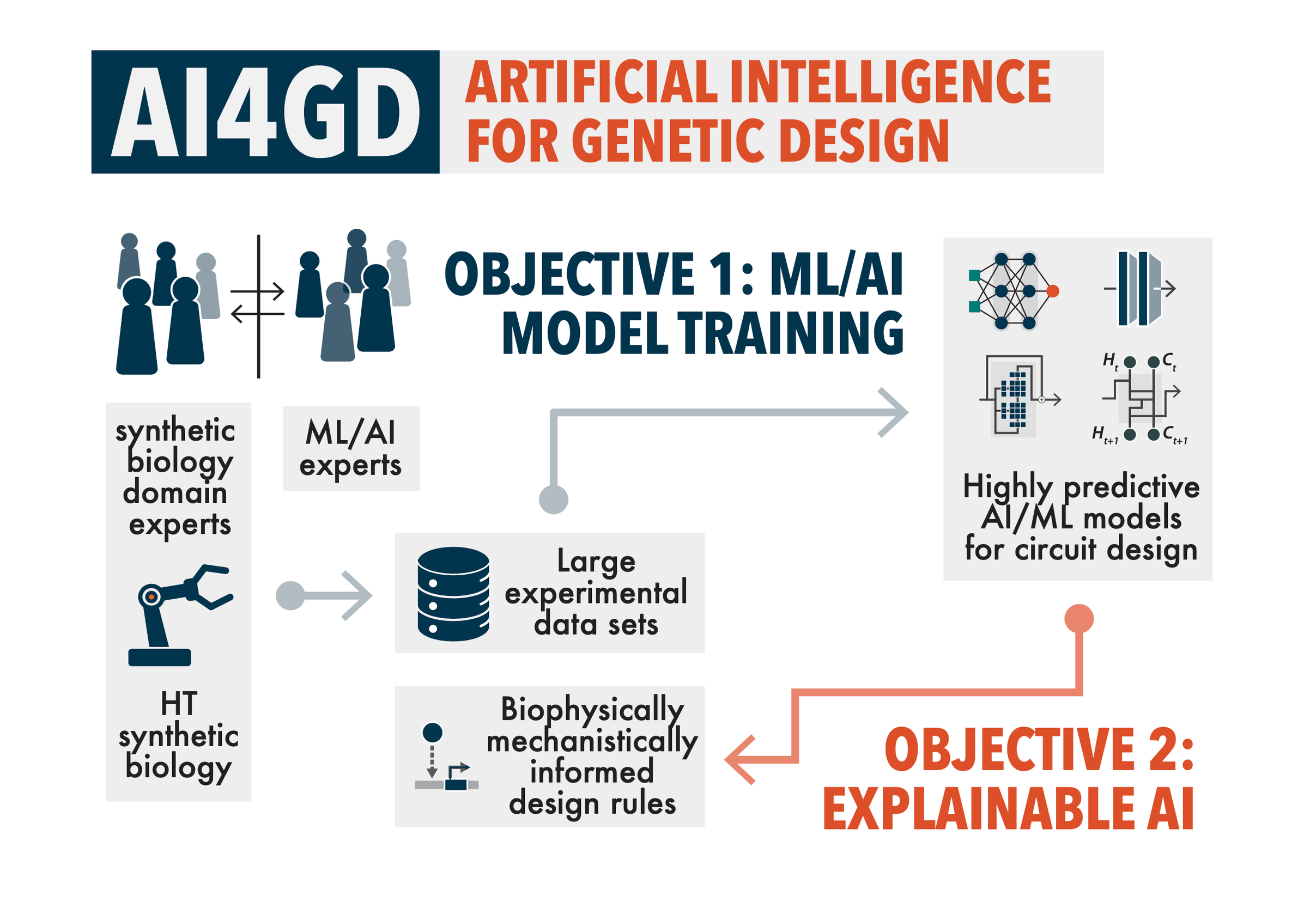
Despite tremendous progress in molecular biology over the last 50 years, our ability to predict the behavior of DNA-encoded molecules and systems based on their underlying genetic code remains limited. The AI for Genetic Design (AI4GD) group combines machine learning and AI researchers with experimental synthetic biologists to develop innovative computational solutions to biotechnology challenges. The team focuses on leveraging existing and currently accumulating datasets to predict functional properties of genetic parts and their interactions while improving interpretability and generalizability of the AI models by incorporating biophysical knowledge into the model architectures.
Cluster Members
- PI: Oleg Igoshin (BIOE)
- Co-Is: Caleb Bashor (BIOE), Ankit Patel (ECE), Meng Li (STAT)
- Associates: James Chappell (BIOS), Cameron Glasscock (BIOS), Joff Silberg (BIOS), Todd Treangen (CS)
-
Research Vision
-
Despite tremendous progress in molecular biology over the last 50 years, our ability to predict the behavior of DNA-encoded molecules and systems based on their underlying genetic code remains limited. In synthetic biology, predictable engineering of cells would revolutionize a wide range of biotechnology applications, from cell and gene therapy to environmental sensing and green fertilizers. Nevertheless, even for the simplest systems, our ability to rationally design the DNA sequences that give rise to desired emergent functions remains a fundamental challenge. Many current genetic design approaches, rooted in traditional biophysical and system biology models, are often oversimplified and unable to bridge the design-to-function gap. In contrast, AI-based approaches have recently proven to outperform the first principle-based approaches for protein structure prediction and the creation of proteins with new and improved functions. Multiple experimental labs at Rice have pioneered high-throughput (HT) approaches for the design-build- test-learn cycle of synthetic biology. Combining these efforts with state-of-the-art AI methodologies being developed here would put us at the forefront of the field. We foresee the creation of an externally-funded multidisciplinary research center aiming to leverage AI and HT approaches for the design of regulatory circuits with precise input-output behavior. As a first step towards this goal, we propose the creation of a research cluster titled AI for Genetic Design (AI4GD) focused on developing computational and theoretical approaches with two broad goals: (1) developing ML/AI models that leverage existing and currently accumulating datasets to predict functional properties of genetic parts and their interactions that overperform first-principles biophysical models and (2) improving interpretability and generalizability of the AI models by incorporating biophysical knowledge into the model architectures. By enabling ML/AI researchers to work with experimental synthetic biologists — two groups of well-established research strengths at Rice—AI4GD will nucleate a cross-disciplinary team that develops innovative computational solutions to biotechnology challenges.