
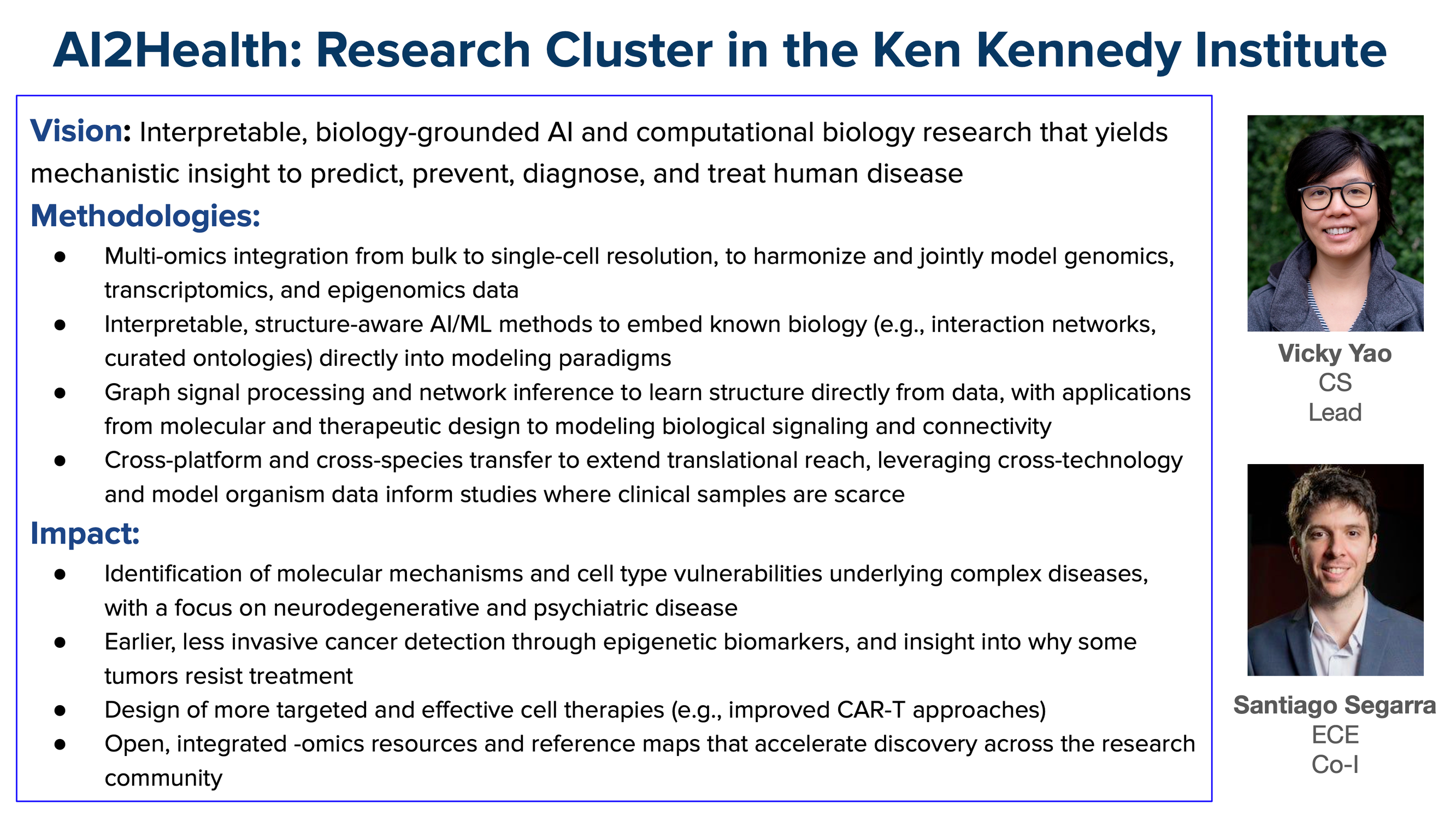
The AI and Computational Biology for Health (AI2Health) research cluster aims to position Rice as a leader in interpretable, biology-grounded AI and computational biology research that yields mechanistic insight to predict, prevent, diagnose, and treat human disease. They will use multi-omics integration, structure-aware machine learning methods, graph signal processing and network inference to advance minimally-invasive cancer detection, design more targeted and effective cell therapies, and accelerate discovery through open, integrated-omics resources and reference maps.
Cluster Members
- PI: Vicky Yao (CS)
- Co-Is: Santiago Segarra (ECE)
- Associates: Luay Nakhleh (CS), Lydia Kavraki (CS), Ivan Coluzza (CHEM), Linna An (BioSciences), Cameron Glasscock (Biosciences), Yousif Shamoo (BioSciences), Lauren Stadler (CEVE), Todd Treangen (CS)
-
Research Vision
-
Since the arrival of omics data, scientists have applied computational techniques to research questions in the biosciences, such as monitoring infectious diseases, predicting genes relevant to human health and disease (e.g., cancer and Alzheimer’s), and characterizing microbiomes (human host-associated, wastewater, etc.). Today, the juxtaposition of petabyte-scale omics datasets, improvements in computational hardware (CPUs and GPUs), and rapid advances in AI/ML have set the stage for a transformative new paradigm in AI2Health research. For example, the recent success of AlphaFold in protein structure prediction marked an important milestone for the community, highlighting the potential of machine learning approaches combined with gold-standard training datasets to advance fundamental biological questions. Our long-term vision for our Ken Kennedy Institute-supported research cluster is to build custom-fit, biologically informed AI/ML approaches to form a foundational toolkit enabling the exploration of new frontiers in AI and Computing for Biology and Health; deploy these tools to the public domain; and form targeted collaborations to refine predictions for specific biomedical and public health questions.
2026 Strategic Refocus:
Building on two years of foundational work, the AI2Health cluster will refocus its research agenda around two integrated, high-impact thrusts that map our methodological strengths onto areas of greatest societal need. Thrust 1: Clinical Omics and Human Health (Yao and Segarra), and Thrust 2: Biosecurity, Biosurveillance, and Public Health (Segarra and Treangen).
The cluster led by Vicky Yao will focus on Thrust 1 to develop AI methods for integrating multimodal single-cell, bulk, and spatial omics data with clinical phenotypes to advance precision medicine in cancer, neurodegeneration, and immune-related disease. This thrust is anchored by Texas Medical Center partnerships with Ken Chen (Professor, Department of Bioinformatics and Computational Biology, MD Anderson Cancer Center), whose group leads single-cell and spatial omics for cancer, and Fritz Sedlazeck (Associate Professor, Human Genome Sequencing Center, Baylor College of Medicine), whose long-read sequencing and structural-variation expertise complements the cluster’s graph-based methods. Together, they provide a translational pipeline from method development at Rice to patient-relevant validation across the TMC.